


How NASA uses Color Science to create beautiful color Images of Space.

Site Sight*
Yes you saw that! And this too!
So how do we see?
To understand how colors work we must first understand how we see in real life. Believe me its more complex than it seems but yet very easy to understand!

As you can see above in the internal structure of the eye we have the retina at the very back of the eye. If you think of your eye as a camera, then the Retina would be the photographic film. This is where the light strikes and an image is recorded.
Now the retina also contains nerves the nerves relay information to the photo receptors that then tell the brain what the eyes are seeing. Now there are two types of receptors. Cones and Rods. But we will focus on Cones.
Now cones are microscopic and lie within the retina of the eye and are very special. This is because they help us do something fundamental and that is interpret visible light.
Visible Light Spectrum
We know that the Electromagnetic Spectrum varies with wavelength and frequency. Giving us Infrared and UV lights even radio waves and microwaves. Now if you think about it, Visible Light lies somewhere in the middle.
Visible light as the name suggests is the light we can see.
The spectrum looks like this;

Rainbow like colors yes?
But what are the main colors of the rainbow?
Red, Green and Blue. (RGB)
Now back to the cones in your eye. They are three for each color: Red, Green and Blue. Below is a photo of the cones and the EMS.


Forget the rainbow and all its colors. Now understand that all those colors are a composite of the three colors mixed to bring out all the different colors like Burgundy or Teal and Cyan. Even Beige (a pale sandy fawn color. Source: Wikipedia) like I even understand what that meant…but yeah so do you.

RGB COMPOSITE FT: ALIM KHAN
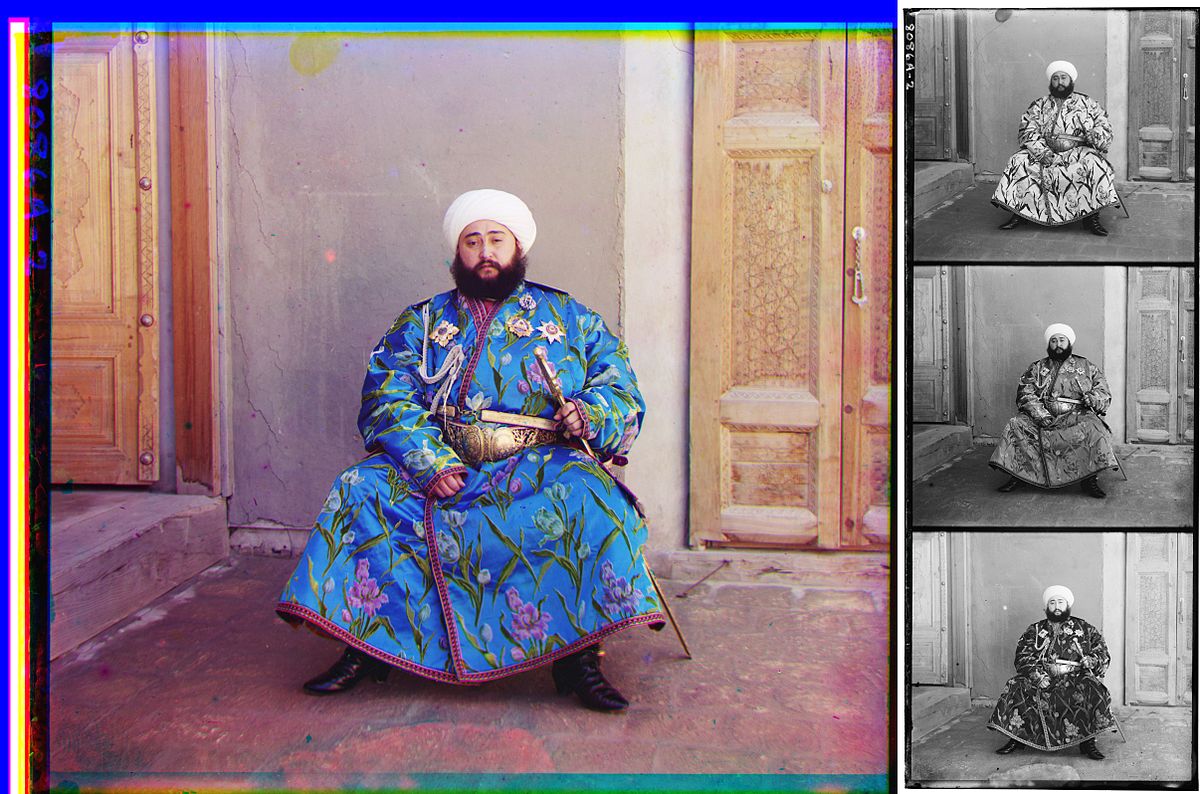
See this photo, this is Alim Khan. This photo was originally black and white. Full color cameras were released in the 60’s and 70’s. After gaining loads of popularity. This photo was originally shot in black and white but with a trick to it.
The photographer at the time used three different filters for the three main colors of the spectrum, RGB.
The filters allowed the respective colors to penetrate most as per the filter as seen on the right of the image above are the three composites with Blue at the top that’s why the clothes look almost white, then Green and Red.
Now when all those different photographs are put together in their different color composites. That is with blue as the overlay and so on. They make a full color photograph of Alim Khan as first suggested by James Clerk Maxwell in 1855 and then shot and tested by Thomas Sutton.
Now the same theory is what we do today at NASA.
The Hubble Space Telescope, HST
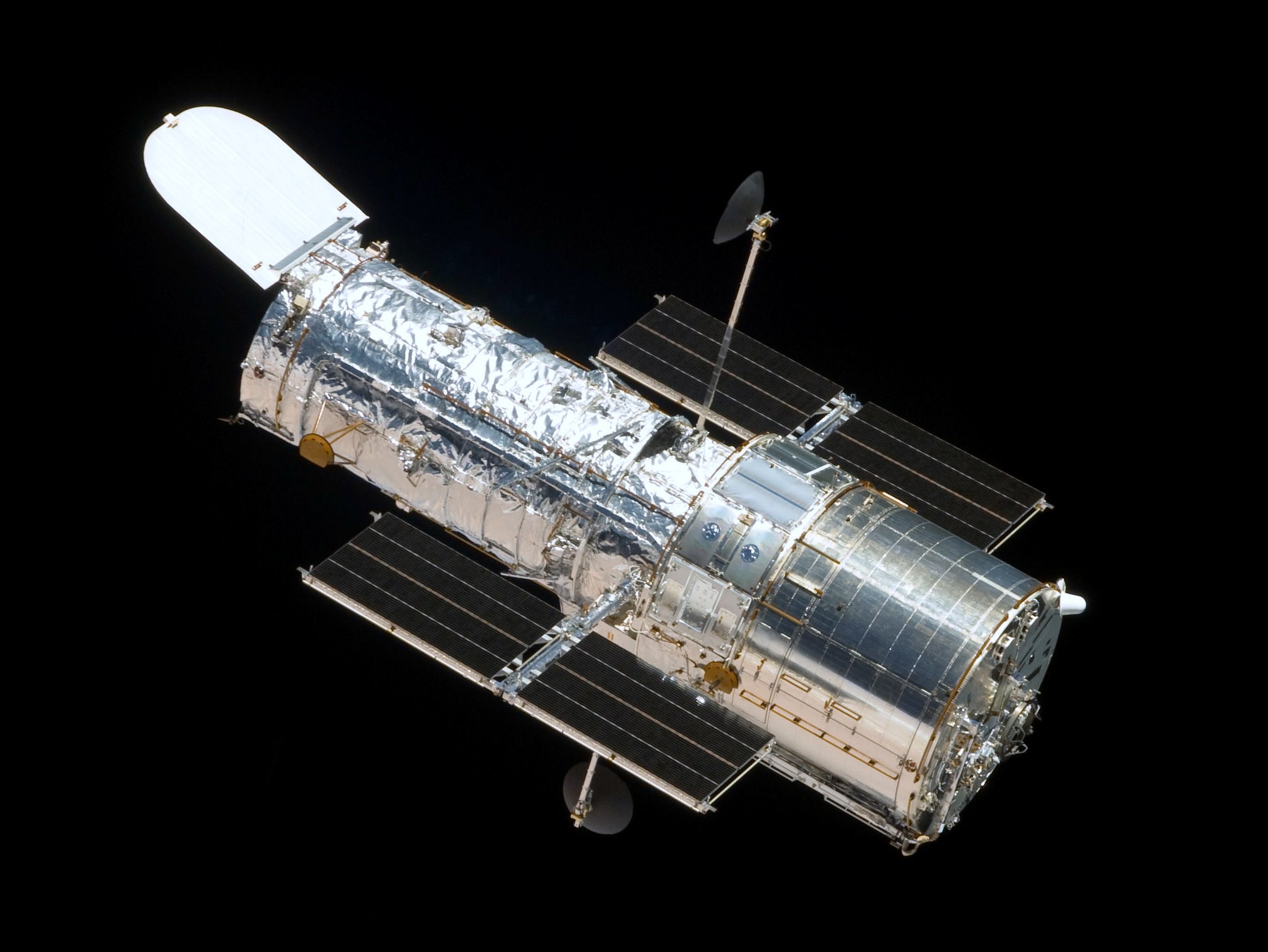
The Hubble Space Telescope has been in existence since 1990 and is this amazing NASA telescope that orbits the earth and is suspended in it.
It was not the first space telescope, but it is one of the largest and most versatile and is well known as both a vital research tool and a public relations boon for astronomy.
Wikipedia
The Hubble Space Telescope takes amazing shots of deep space and even the planets around us. In context it has been able to probe the black hole of the majestic spiral galaxy NGC 3147 located 130 million light-years. That is light would take about 130 million years to reach your eye.

To do this it has to maximize light to the best of its advantage to get super clear photos that you see around.
This is best done in black and white.
Lastly let us Photoshop!
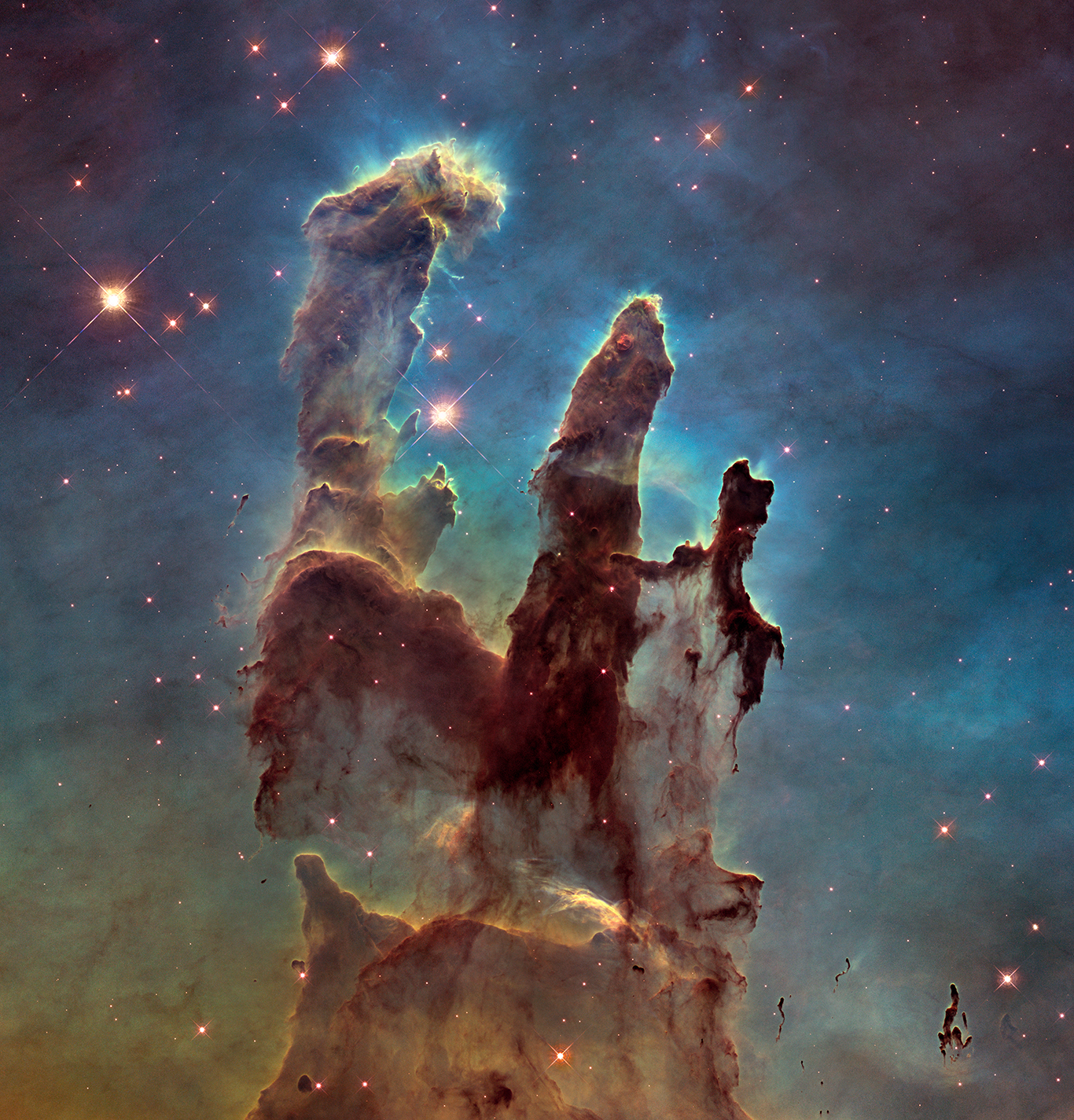
Now you’ve probably seen this image:

Source: NASA Gov
They are called the pillars of creation because if you zoom in a little closer you will see gases and explosions yielding new stars!
NASA’s Hubble Space Telescope has revisited the famous Pillars of Creation, revealing a sharper and wider view of the structures in this visible-light image. Astronomers combined several Hubble exposures to assemble the wider view. The towering pillars are about 5 light-years tall. The dark, finger-like feature at bottom right may be a smaller version of the giant pillars. The new image was taken with Hubble’s versatile and sharp-eyed Wide Field Camera 3. The pillars are bathed in the blistering ultraviolet light from a grouping of young, massive stars located off the top of the image. Streamers of gas can be seen bleeding off the pillars as the intense radiation heats and evaporates it into space. Denser regions of the pillars are shadowing material beneath them from the powerful radiation. Stars are being born deep inside the pillars, which are made of cold hydrogen gas laced with dust. The pillars are part of a small region of the Eagle Nebula, a vast star-forming region 6,500 light-years from Earth. The colors in the image highlight emission from several chemical elements. Oxygen emission is blue, sulfur is orange, and hydrogen and nitrogen are green. Object Names: M16, Eagle Nebula, NGC 6611 Image Type: Astronomical Credit: NASA, ESA, and the Hubble Heritage Team (STScI/AURA)
NASA GOV
Having understood that the pillars of creation are a composition of the three gases Oxygen, Sulfur and Nitrogen. It is now time we Photoshop!
The Hubble takes the photos with the composites, Red Green and Blue according to the emission of the gases.
The filters original images are as seen below:
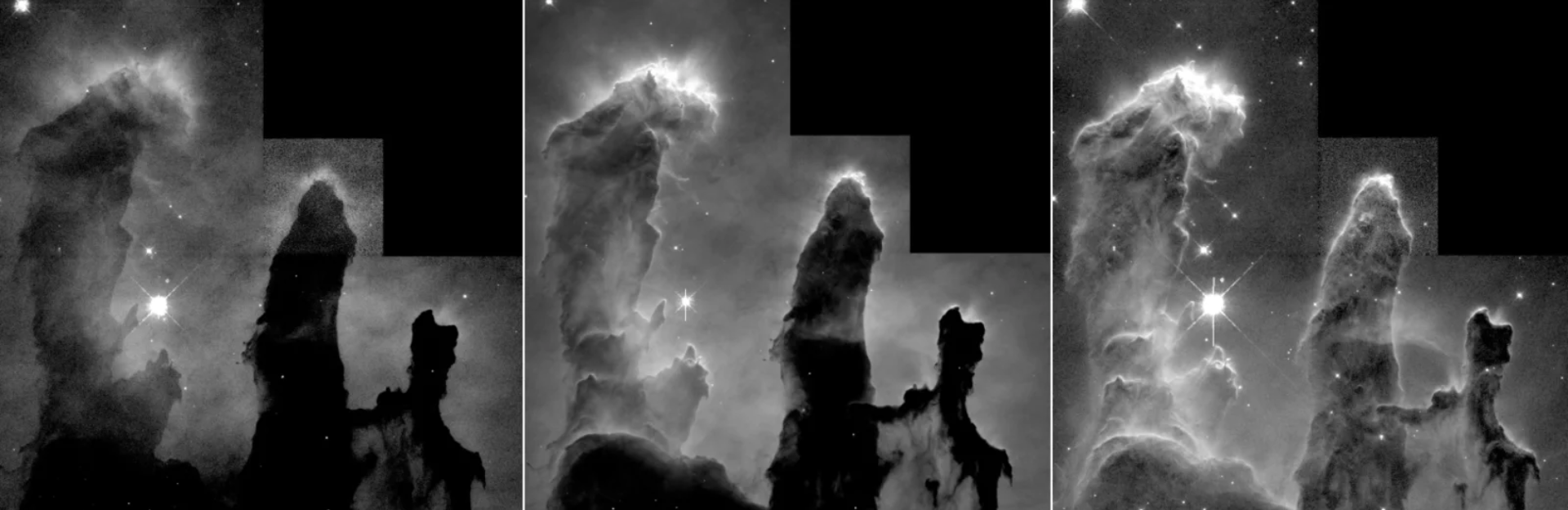
Now in Photoshop the three different photos as taken in their RGB filters are overlayed with their respective color narrow- band wavelengths. Then combined and retouched. Presenting a wonderful image that is not only for wallpapers, but that NASA uses as data.
If NASA wanted, they would leave all of the photos taken, in black and white. The purpose is greater and that is DATA.
The same happens with the planets in orbit like Jupiter, Saturn and the likes which are far away. To get the accurate colors we use the three color composite method only now we use a broadband spectrum as the objects are solid hence in true color.

Takeaways?
No not that the photos are not real and are thus photoshoped. No that is not it!
The key takeaway is that scientists have to understand the key color science components and even understand the biology and physics behind your eyesight in order to allow scientific development such as the wonderful exploration of space to go on!
Nonetheless, as I said, NASA could’ve left them in black and white but that wouldn’t help many of us as such (Wallpapers). They do it because of the data that comes from it and the result of constant analysis and use of tools such as Adobe’s Photoshop are what yield wonderful developments and growth in space and science itself.
That is all for today, Keep Sparky!
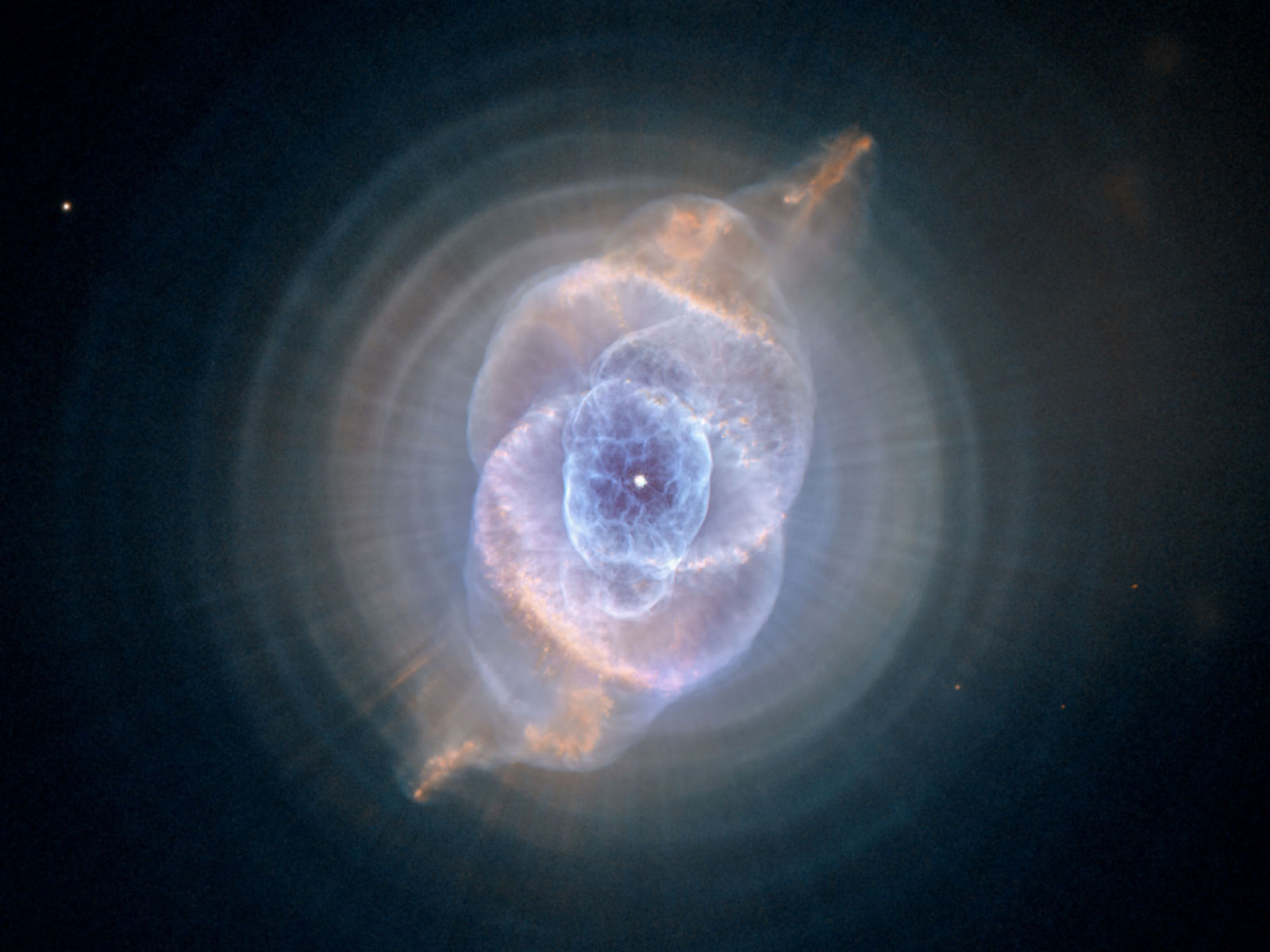
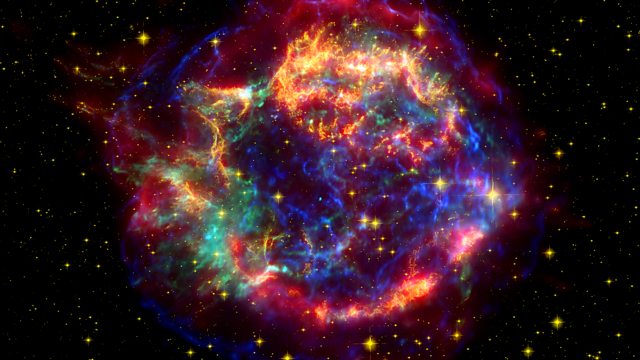
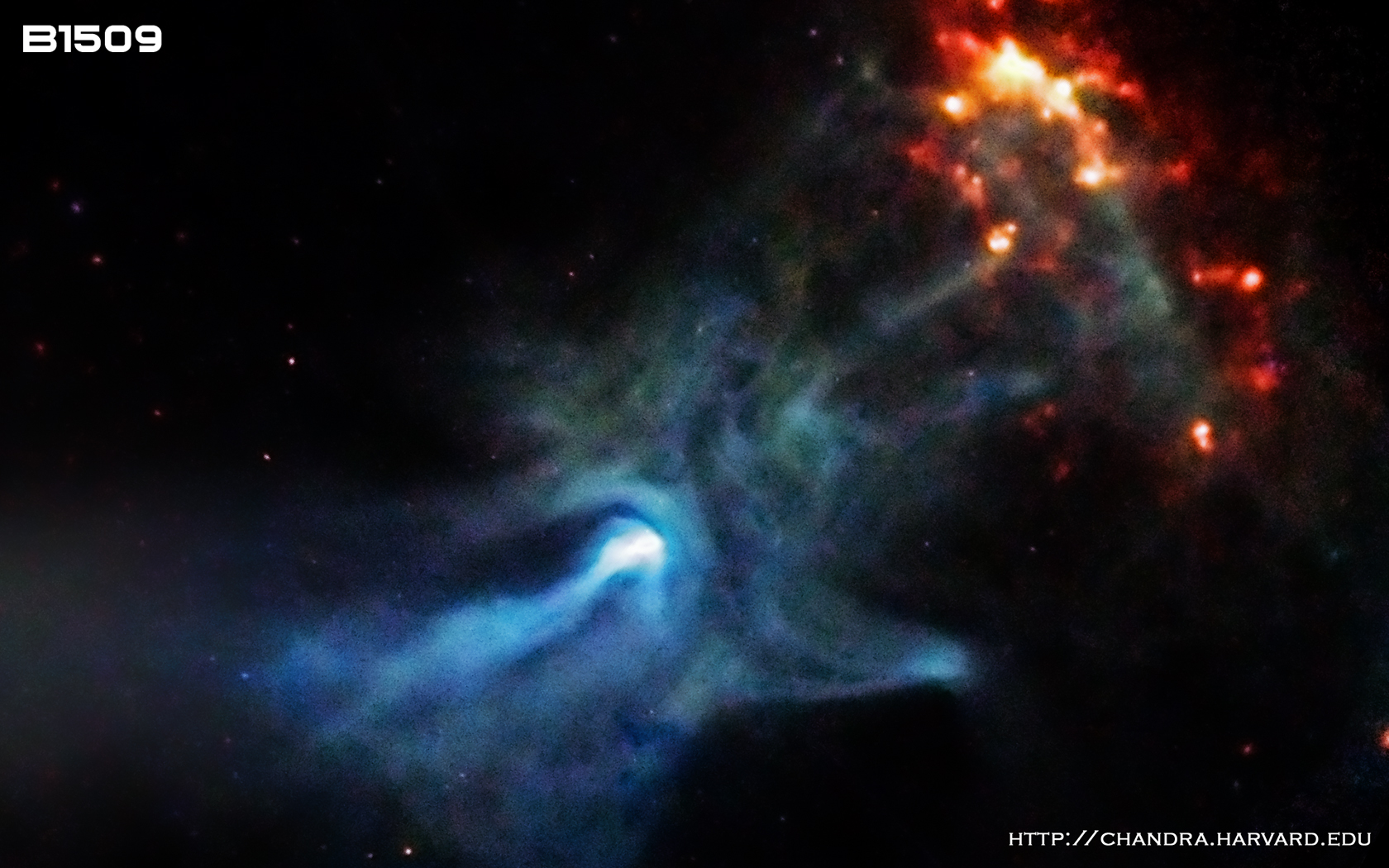
I’ll leave a collage of my the best shots I obtained of space while writing this blog!




Video Resources
Vox: How Scientists Colorize photos of space!
National Geographics: Iconic Space Images are actually black and white!
 Sparky Science
Ryan, you have given me great insights. And you added color to the science. Well done!
LikeLike
Thank you so so much. I am glad to have added insights to you and even to my greater audience 💫
LikeLike
This is so enlightening. Looking forward to learning more about the eye. Thanks
LikeLike
Colorful and insightful (no pun intended) let me internalize first then come up with questions
LikeLike